
BEIJING, Oct. 26 (CNR News) — According to the website of the Ministry of Finance, in a move to increase the procurement of green and low-carbon products and comprehensively promote green buildings and building materials, the Ministry of Finance, the Ministry of Housing and Urban-Rural Development, and the Ministry of Industry and Information Technology have decided to further expand the implementation scope of the policy leveraging government procurement to support green building materials and enhance building quality. This decision follows a pilot program in six cities: Nanjing, Hangzhou, Shaoxing, Huzhou, Qingdao, and Foshan. A relevant notice has been issued .
The notice indicates that starting from November 2022, the policy will be implemented in 48 cities (including municipal districts), including Beijing's Chaoyang District . Projects covered under this policy include government procurement projects for hospitals, schools, office buildings, complexes, exhibition centers, convention and exhibition centers, stadiums, and government-subsidized housing, which also fall under the scope of the Government Procurement Law and the Bidding Law. Relevant cities may choose specific projects for initial implementation and gradually expand the scope based on gained experience, aiming for full coverage of government procurement projects by 2025 .
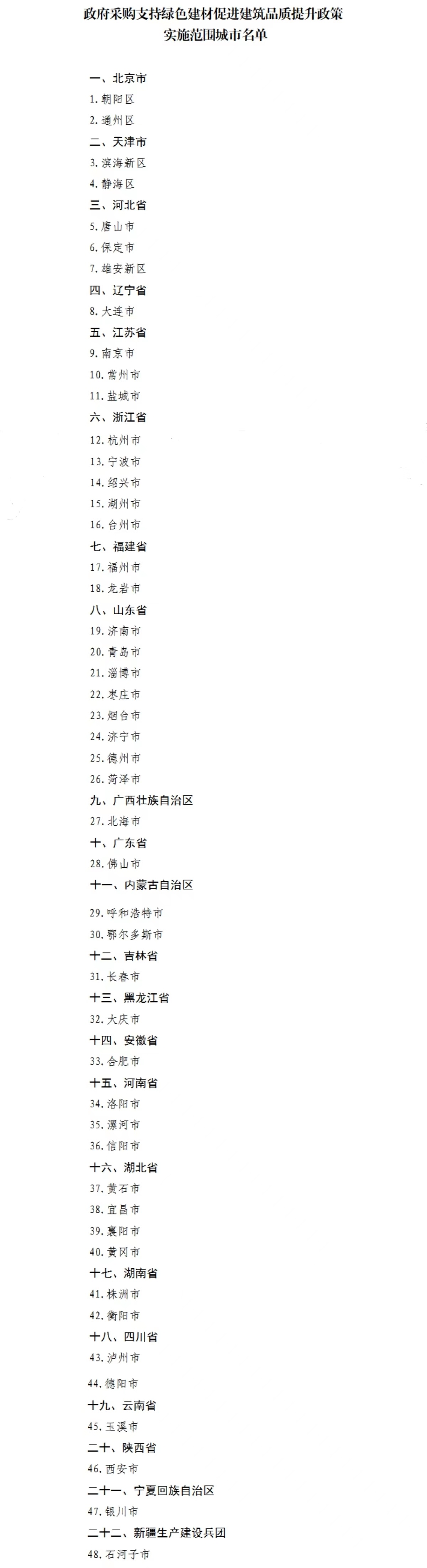
(City List for the Implementation of the Government Procurement Policy Supporting Green Building Materials and Building Quality Improvement. Source: Ministry of Finance website, published by CNR News)
It is understood that in October 2020, the Ministry of Finance and the Ministry of Housing and Urban-Rural Development issued a notice launching a pilot program in the six cities of Nanjing, Hangzhou, Shaoxing, Huzhou, Qingdao, and Foshan . The pilot aimed to promote the use of recyclable and reusable materials, high-strength and high-durability materials, green components, green decoration materials, and water-saving and energy-saving materials in government procurement projects. It also encouraged the adoption of assembled and intelligent construction methods and achieving green building standards of at least a two-star rating .
The latest notice significantly expands the coverage of this policy and outlines the following key tasks:
(I) Fulfilling Government Procurement Policy Requirements.
All relevant cities must strictly implement the "Government Procurement Demand Standards for Green Buildings and Building Materials"(hereinafter referred to as the "Demand Standards") formulated by the three ministries . Requirements should be embedded at various stages: during project initiation into proposals and feasibility studies; in bidding documents and contracts as substantive conditions during procurement; through strengthened on-site supervision during construction to ensure compliance; and by developing corresponding acceptance criteria based on the Demand Standardsduring project acceptance. Projects passing acceptance are encouraged to apply for green building labels .
(II) Strengthening the Procurement Management of Green Building Materials.
For projects within the policy scope, the use of building materials categorized in the Demand Standardsmust fully comply with the relevant standards . Cities are to explore bulk centralized procurement for generic green building materials and promote electronic procurement platforms to enhance efficiency and transparency. Suppliers must provide certification or test reports proving compliance with the standards .
(III) Improving the Government Procurement Demand Standards for Green Buildings and Materials.
Relevant cities may propose optimizations to the Demand Standardsbased on local characteristics and needs, such as adjusting indicators, adding new product standards, or refining standards for specific building types like schools or hospitals. These suggestions will be reported to the three ministries, which will dynamically adjust the Demand Standardsbased on feedback and policy implementation .
(IV) Prioritizing Project Payment Settlements.
For projects under this policy, the proportion of project progress payments should be increased to no less than 80% of the completed work value . Implementing construction process settlement is encouraged, where payments are made for completed, undisputed work phases, with these settlements forming part of the final account and not re-audited upon completion in principle .
The notice requires actively promoting the application of green buildings and building materials through government procurement policies, vigorously developing new construction industrialization methods like assembled and intelligent building, and comprehensively constructing green buildings of at least a two-star rating . This aims to establish a long-term mechanism supporting the green and low-carbon transition in the construction sector, leading to high-quality development in the building materials and construction industries, and building livable, green, low-carbon cities .